

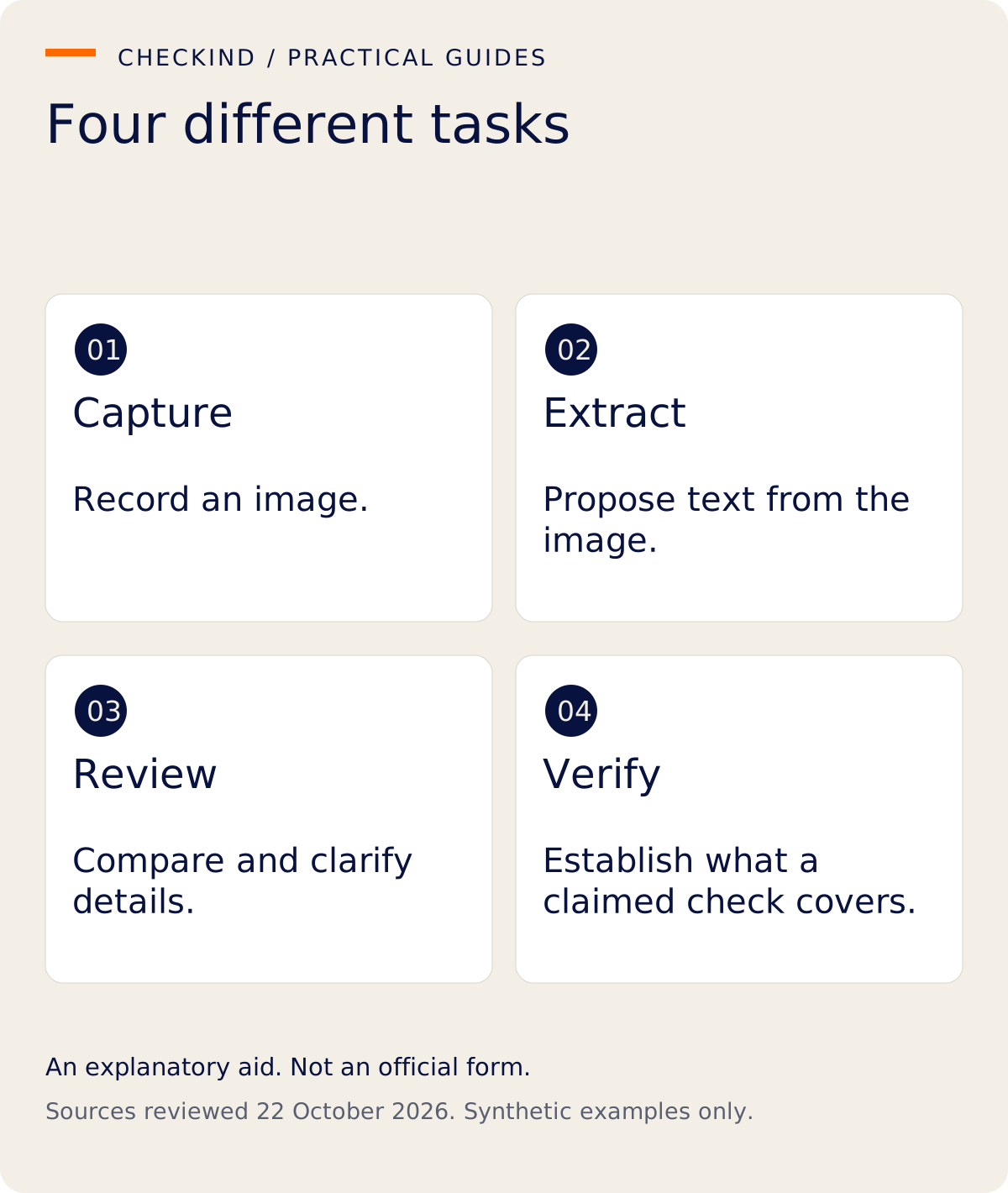
Document capture stores or records an image. Optical character recognition, or OCR, proposes text from that image. Human review checks the proposed information against its source and the guest's answers. Identity verification is a separate set of checks whose meaning depends on the service and process being used.
A hotel should ask what each software feature actually does before describing the whole journey as “verified.” This guide is for Indian owners evaluating registration software, including properties that receive foreign guests. It does not recommend treating a scan or a matching name as proof of authenticity.
Four tasks that should not share one label
| Task | Useful question | Limit to remember |
|---|---|---|
| Capture | Can a usable image be provided through the intended route? | A readable image can still depict an invalid document |
| Extract | Which fields are proposed, and can they be corrected? | Proposed text can contain mistakes |
| Review | What exactly does a person compare or confirm? | Completeness review is not every form of verification |
| Verify | What evidence supports the claimed check? | A broad marketing label does not explain the method |
Different products may combine tasks, but the seller should explain the boundaries. Do not assume that a demonstration with a fictional card proves handling of every real document, language, device or exceptional case.
Ask to see an imperfect example
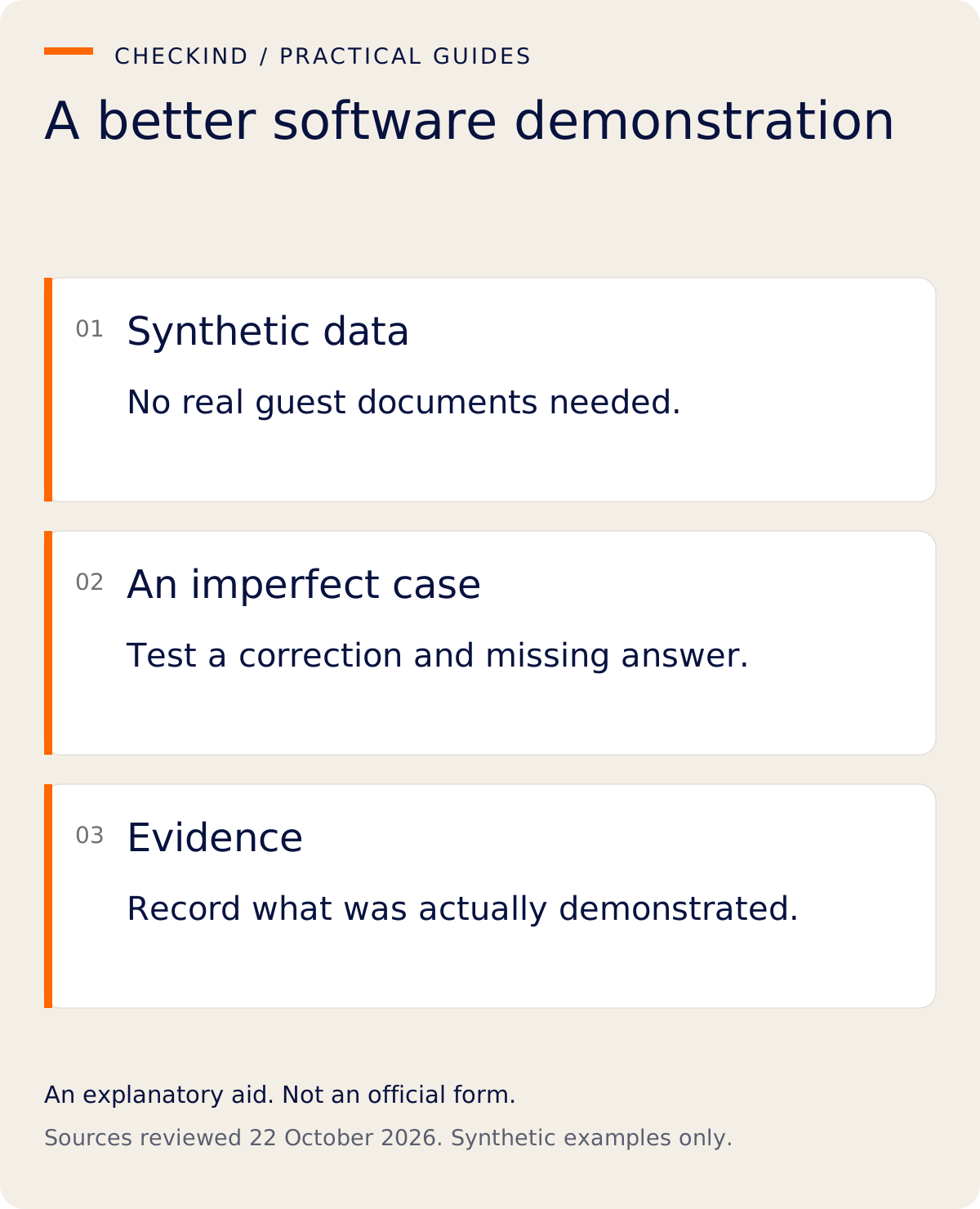
A polished demo often shows a clear image and a successful path. Ask instead what happens when a field is unclear, the image is cropped or the guest corrects a spelling. Use synthetic material, not a real guest's passport, Aadhaar or visa.
A useful exercise is to introduce a deliberate character mismatch in a fictional document. Can the reviewer see the uncertainty? Can they correct the proposed text? Does the final record make it clear what was entered? This evaluates a workflow without claiming a universal accuracy percentage.
Human review needs a defined job
“Staff will check it” is incomplete unless the property defines the check. The reviewer may compare the transcription with the source, ask about missing journey information, confirm the booking context and escalate an inconsistency. Those actions should be described specifically.
If a tool claims authenticity or presenter checks, ask what evidence and method support the claim and what exceptions remain. Do not extend a limited check to a blanket conclusion that the guest, document, travel authorization and stay are all legally verified.
Review document handling before enabling extraction
Ask where an image goes, which processors receive it, who can access it and what deletion or retention process applies. Ask how these answers are evidenced, rather than accepting “secure” as a complete explanation.
The exact obligations depend on the data and context. This article does not claim that a checklist, software purchase or signed privacy policy establishes legal compliance. Give unresolved questions to the people authorized to make the property's data decisions.
Foreign guest reporting remains a separate task
A passport image does not supply every travel answer or actual-stay event. Even accurate extracted particulars do not establish that an official report was transmitted. The Form III schedule and Rule 17 should inform the reporting process rather than a scanner's animation.
Keep government reporting, staff confirmation and extraction outcomes separate in product evaluation. Ask what evidence is shown after each step. An operator-entered external reference should be described as operator-entered unless independently verified through an authorized system.
A software demonstration worksheet
Ask the provider to show the following with fictional data:
- A clear capture and an image that needs assistance.
- Proposed fields with the source visible to the appropriate reviewer.
- A correction to a deliberately incorrect character.
- A missing answer that cannot be inferred from the image.
- The route for a guest who needs manual help.
- The actual access and retention controls being claimed.
- The difference between saving a record and completing official reporting.
Record “not demonstrated” where evidence is missing. That is more useful than marking a feature as working because the sales presentation contains its name. Compare alternatives against the same exercise.
CheckInd's current boundary
CheckInd supports identity-document capture and digital guest registration in its production-evidenced workflow. OCR-assisted extraction is under review and is not being promoted as currently available. No extraction accuracy or automatic identity-verification claim is made here.
Use the document-capture page to understand the current position. A public illustration of auto-filled fields should not override release evidence or the stated availability limit.
Questions owners ask
Does OCR mean fewer typing mistakes?
It may change the typing task, but this article claims no measured improvement. Review the real feature, uncertainty handling and corrections.
Can we test with a customer's passport?
Synthetic examples are sufficient for an initial process demonstration. Real document testing requires separate authority and appropriate data controls.
Does saving an extracted record file Form III?
No. Extraction, registration and official government submission are separate tasks.
Before comparing prices, agree what you need the reviewer to accomplish. Then ask each provider to demonstrate that work, including the case that does not go smoothly.
Operational suggestions and synthetic examples. They do not establish government approval, feature availability or legal compliance.
- CheckInd current Form III product boundary — Digital registration is available; expanded Form III preparation remains in development.
- Immigration and Foreigners Rules, 2025; G.S.R. 596(E), 1 September 2025 — Rule 17(1), (5), (6), Form III schedule