

A useful reception handover tells the next person what happened, what remains open, who owns the next action and where the authorized record is kept. For a foreign guest stay, it should distinguish registration review, actual arrival or departure, and official reporting. One vague “done” label cannot explain all three.
This template is for a small Indian hotel or owner-run property changing shifts. It is an operational recommendation, not an official register, prescribed form or claim that a particular software offers task assignment.
Start with an internal stay reference
Identify the correct property and stay using the reference your team is authorized to use. A handover does not usually need a full passport number in its heading. Avoid copying sensitive particulars into a general-purpose group chat simply because the original registration is difficult to find.
The next reviewer should be able to reach the authorized record, understand their permitted access and see what needs attention. If the record is inaccessible, say so. Do not describe missing access as missing guest information.
Write the unresolved question in plain language
Compare “verification pending” with “ask guest to clarify the previous place of stay.” The second instruction explains the next action. Similarly, “filing to check” is less clear than “authorized operator to check official arrival-submission evidence.”
Use the narrowest accurate statement. A transcription reviewed against a supplied image is not the same as proof of authenticity. An external reference entered by staff is not necessarily independent confirmation from a government system.
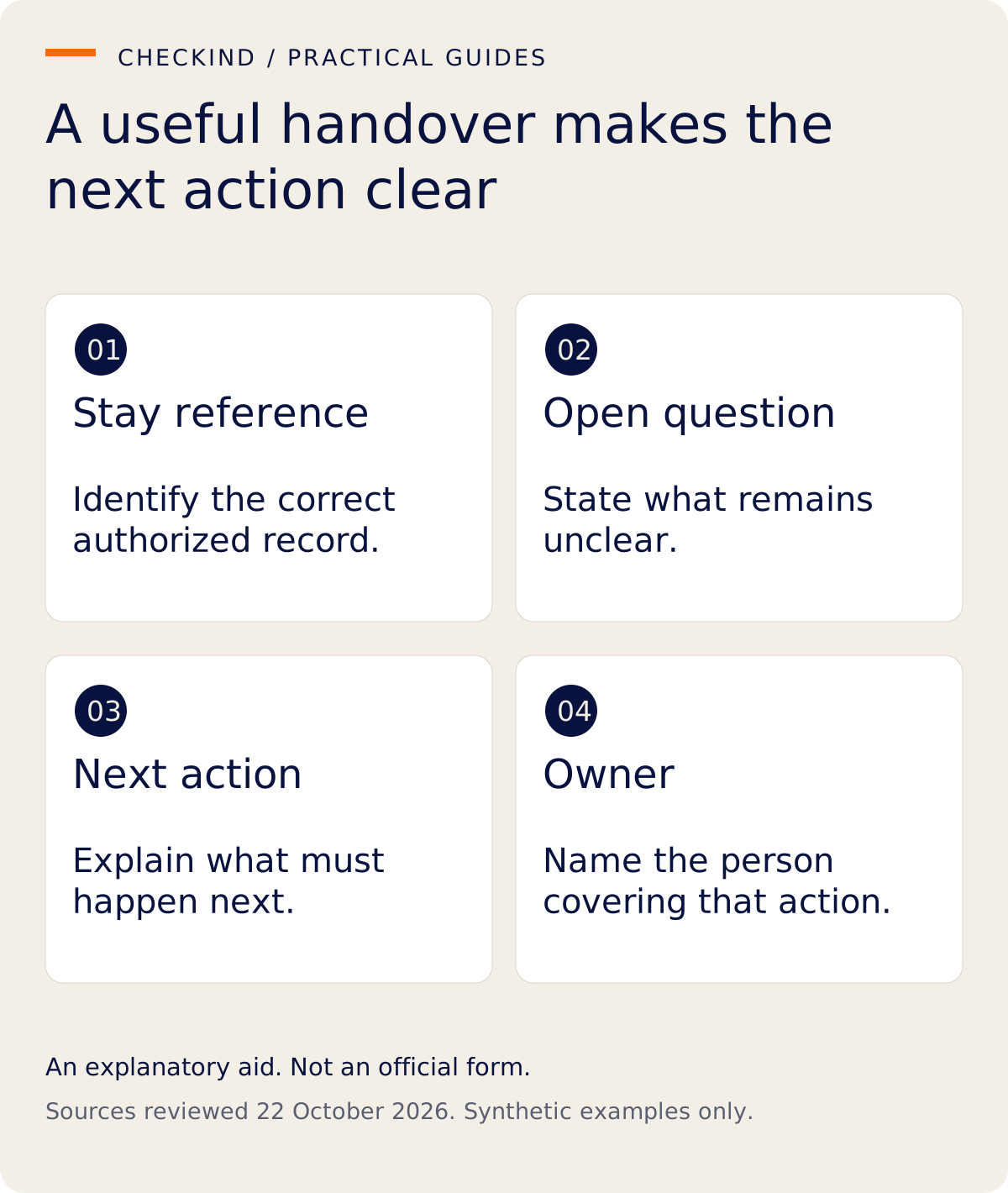
A suggested handover template
| Field | What to record |
|---|---|
| Property / stay reference | Enough to identify the correct authorized record |
| Actual event | Confirmed arrival or departure date and time, or explicitly unconfirmed |
| Current task | Registration review, missing particular or official reporting check |
| Open question | The precise issue that needs clarification |
| Next action | What the next person should do |
| Responsible person | The person covering the action |
| Evidence location | Authorized record or official receipt location, not a public document URL |
| Escalation | Who handles a question outside reception's authority |
Use only the fields needed for your operation. A template should make work visible, not collect additional sensitive information by default.
Keep the two reporting tasks visible
Under Rule 17(5) and (6), arrival particulars and departure details have separate reporting limits. The actual events matter. A reservation date or a completed pre-arrival form does not confirm them.
The handover should identify who completes the designated official process and who checks the result. If the next shift starts while a task is open, make the owner explicit. Do not assume that the person who collected the passport image has also completed reporting.
A fictional evening handover
At illustrative Cedar Rooms, the afternoon reviewer has collected registration details but needs the guest to clarify a journey answer. The guest's arrival has been confirmed, and the designated reporting operator is covering official submission.
The handover reads: “Stay T-014: clarify previous place of stay with guest. Reviewer: evening lead. Official arrival report: reporting operator to check completion evidence. Departure particulars: confirm at actual checkout.”
This example deliberately omits identity numbers. It illustrates a division of work, not a government-approved workflow or a working CheckInd task board. The property still needs its own applicable reporting and data process.
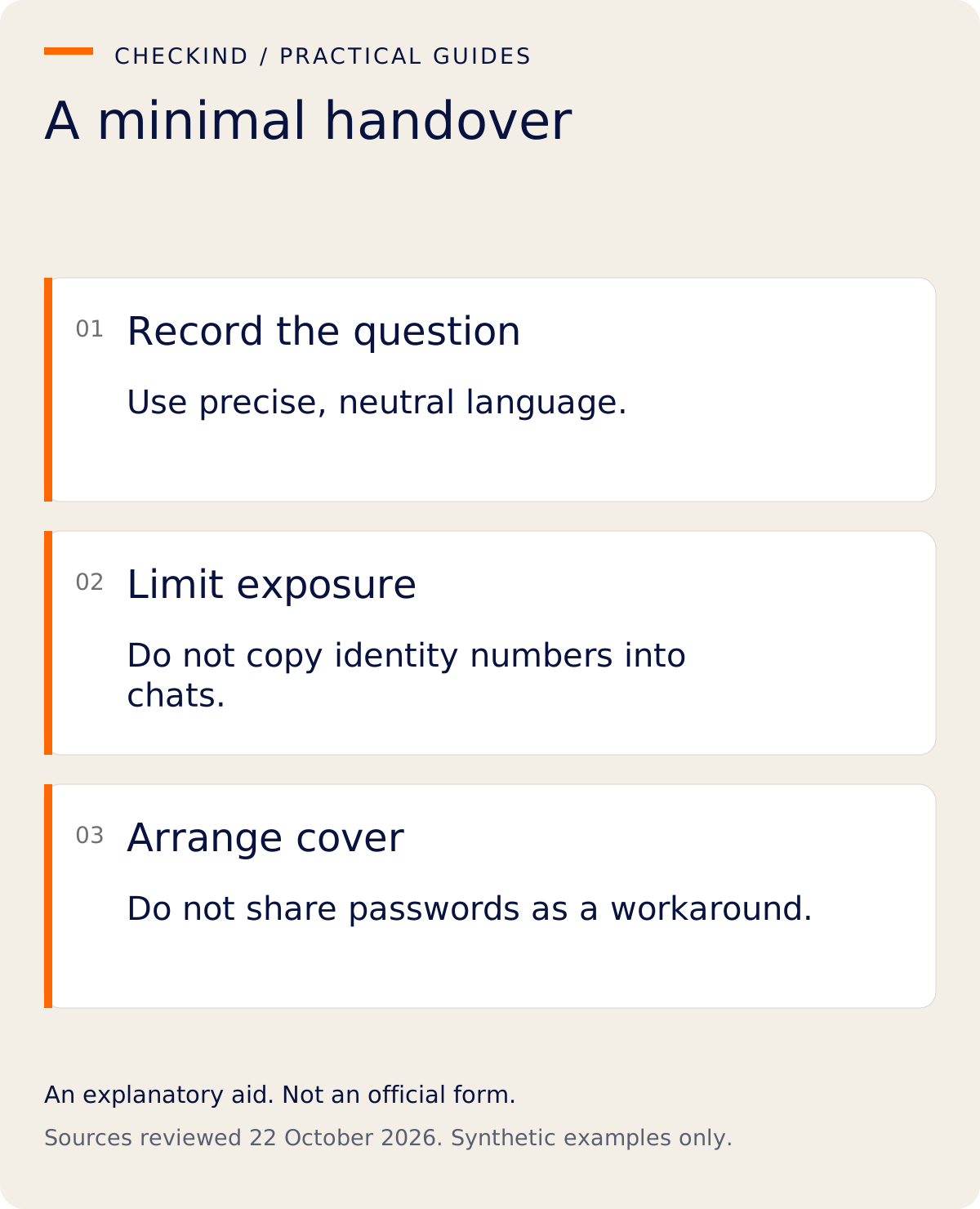
Cover absence and uncertainty
A process can fail when only one person knows the reporting account or the meaning of a local worksheet. Arrange authorized cover and an escalation route. Do not resolve absence by sharing credentials in a shift note.
If an actual time is disputed, preserve the uncertainty and ask the responsible person to resolve it. If the official portal is unavailable, record the issue accurately and seek the authority's instructions. This template does not establish an approved fallback or grace period.
What to leave out
Avoid guest document images, full identity numbers, passwords, recovery codes, unrelated personal details and commentary about a guest's character. A handover should state the operational question, not turn a concern into an unsupported accusation.
Review who can open the handover and how long it should be retained. Those decisions need the property's authorized policy and applicable requirements; this article does not prescribe a universal retention period for every shift note.
Where CheckInd fits
CheckInd offers digital guest registration and organized property records for review. Expanded staff-confirmed stay events and Form III preparation remain in development. The handover above is a suggested operating practice, not a claim that CheckInd currently provides assignments, escalations or automated deadline tracking.
Questions owners ask
Can one person handle all checkpoints?
A small property may do that, but cover and the remaining tasks should still be clear.
Should every staff member see the original documents?
Do not infer that from a handover. Access should follow the property's applicable process and authorized roles.
Can a generic “complete” status replace the template?
Only if its meaning is precise enough for the next operator. Otherwise, record the actual task and remaining question.
Try the template at one synthetic shift change. Ask the next reviewer to explain the open task back to you before adopting it.
Operational suggestions and synthetic examples. They do not establish government approval, feature availability or legal compliance.
- Immigration and Foreigners Rules, 2025; G.S.R. 596(E), 1 September 2025 — Rule 17(1), (5), (6), Form III schedule
- Immigration and Foreigners (Amendment) Rules, 2026; G.S.R. 424(E), 1 June 2026 — Amendments to Rules 12, 18 and 21; no amendment to Rule 17 in this instrument
- Official Form III public portal — Public notice includes OCI; no authenticated procedure tested
- CheckInd current Form III product boundary — Digital registration is available; expanded Form III preparation remains in development.